Natural gas engines vs. diesel engines
Originally published May 2022; Updated June 2026
Summary
Natural gas engines have emerged as a strong alternative to diesel for heavy-duty commercial fleets, offering quieter operation, simpler maintenance, more convenient refueling options, and consistently lower, more stable fuel costs.
From an environmental standpoint, natural gas produces 13 – 17% lower well-to-wheel greenhouse gas (GHG) emissions than diesel, with even greater reductions possible when using Renewable Natural Gas (RNG) made from organic waste.
Drivers find that natural gas engines have similar performance and drivability as diesel engines. The leading difference between natural gas and diesel engines is noise; natural gas engines are quieter.
For fleet managers weighing the switch, natural gas delivers comparable performance and drivability to diesel while providing meaningful cost savings and sustainability benefits.
Natural gas engine vs diesel engine comparisons
| Category | Natural gas engine | Diesel engine |
|---|---|---|
| Noise | Often quieter | Regular amount |
| Refueling options | Standard refueling and option to time-fill overnight | Standard refueling |
| Maintenance | Simple, maintenance free | Advanced system with managed maintenance needs |
| Exhaust aftertreatment | Not required | Routine exhaust gas aftertreatment required |
| Fuel cost | Consistently lower fuel costs with long-term stability | Higher volatility with rising trend |
| GHG emissions | 13–17% lower well-to-wheel GHG and 27% lower CO2 vs. petroleum | Today's clean diesel engines emit 90% less harmful emissions than those produced before 2000 |
| Renewable fuel option | Renewable Natural Gas (RNG) from can achieve sub-zero net GHG emissions | Renewable diesel is often suitable (please always check with your OEM and vehicle manual) |
| Performance & drivability | Similar performance and drivability to diesel | Strong torque, reliability, and durability |
Natural gas offers convenient refueling options
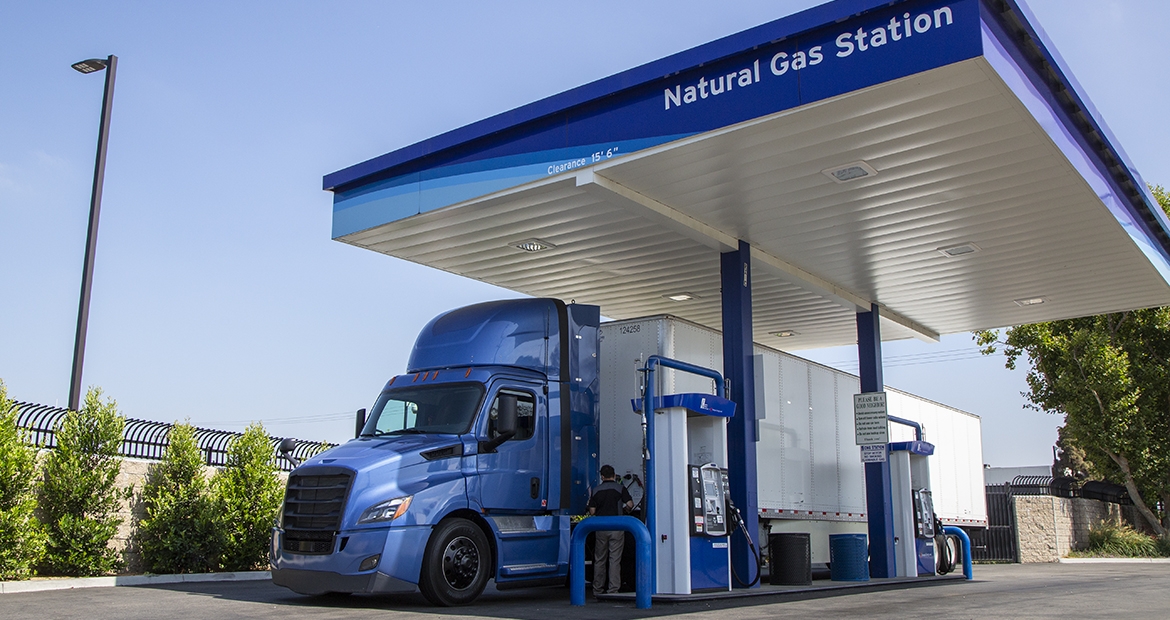
Natural gas also improves the refueling experience for many fleet drivers. In a world of several alternative fuel options for commercial vehicles ranging from natural gas to liquified petroleum gas (LPG); natural gas can be used in a vehicle in either compressed or liquefied form. For fleets with behind the fence refueling capability, natural gas refueling stations can be set up on site to ensure that each vehicle has a dedicated fuel hose. There are two basic types of fueling equipment: fast-fill and time-fill.
Fast-fill systems combine a compressor and a high-pressure storage system. The storage system, called a cascade, fills the vehicle's fuel tank in about the same time it takes to fuel a diesel vehicle. Compressed natural gas can’t spill during refueling and drivers never go home smelling of diesel.
Time-fill systems don’t have a storage system and typically compress the gas directly into the vehicle storage cylinders to refuel vehicles while they’re parked overnight. With time-fill systems, drivers pull into their designated space at the end of their shift, connect a fuel hose to their vehicle’s natural gas cylinder and go home. Drivers don’t need to wait for their turn at the diesel pump and don’t need to wait again until their tank is full. This saves them time and saves their company money.
Natural gas exhaust systems are cheaper and easier to maintain than diesel aftertreatment systems
There are no complicated exhaust gas aftertreatment systems on natural gas vehicles. Modern diesel trucks require a set of sensors, filters and converters to scrub pollutants such as nitrogen oxides and soot from their exhaust. Some converters consume diesel exhaust fluid, or DEF, a water-based reagent whose handling can be challenging in cold weather. Natural gas burns much cleaner than diesel, so few or none of these systems are required on a natural gas vehicle. All of the exhaust is run through a simple three-way catalyst, resulting in significantly low NOx levels.
It is important to closely follow recommended maintenance intervals with natural gas engines, but with proper maintenance, it’s not uncommon for natural gas trucks to reach a million miles. And mechanics often find that maintaining a natural gas engine can be a more pleasant experience because of how clean they are.
Natural gas promotes cost savings
Besides enjoying savings in terms of lower maintenance costs and reduced maintenance downtime, fleet managers can also save big on fuel costs. In the United States, the retail price of compressed natural gas has been consistently lower than the price of diesel since the start of the shale gas boom in the early 2000s. It is also decoupled from the price of oil and therefore has been quite stable. As a result, natural gas fleet operators don’t experience wild swings in fuel prices that other fleets must deal with whenever oil prices rise and the cost of diesel jumps. This comes in addition to all the other benefits natural gas engines offer for transportation applications.
Natural gas cuts greenhouse gas emissions
Natural gas has many sustainability benefits, including 13% – 17% lower well-to-wheel greenhouse gas (GHG) emissions and 27% lower CO2 emissions than petroleum when using virgin natural gas. The benefits really shine when using renewable natural gas (RNG) made with biogas.

RNG can help fleets reach sub-zero GHG emission levels because producing RNG captures biogas like methane that would have otherwise been emitted into the atmosphere through natural decomposition. This biogas comes from the fermentation of organic waste such as animal manure in industrial digesters. Switching to renewable natural gas can be an effective way for these businesses to reach any greenhouse gas reduction objectives they may have. Many transportation businesses operating in agricultural areas have found ways to create win-win partnerships with local farmers willing to invest in a renewable gas production setup. Municipalities and refuse companies that own landfills are able to capture methane generated through waste decomposition and sell that to the RNG fuel producers, essentially offsetting their fuel costs.
If natural gas engines are relevant to your needs, don’t forget to also check our answers to frequently asked questions about natural gas engines. These answers cover topics such as cost, practicality, and feasibility of integrating natural gas into commercial fleets.
Never miss the latest and stay ahead. Sign-up below to receive the latest in technologies, products, industry news, and more.
Frequently asked questions
The long-term cost benefits of natural gas over diesel come down to three areas: lower fuel prices, reduced maintenance costs due to simpler exhaust systems with no DEF or complex filters, and greater vehicle longevity with properly maintained natural gas trucks capable of reaching one million miles.
Natural gas engines offer similar performance and drivability to diesel engines.
Natural gas vehicles can be refueled using either a fast-fill or time-fill system. Fast-fill works similarly to a diesel pump, while time-fill allows drivers to connect their vehicle overnight and leave without waiting.
Natural gas burns cleaner than diesel, eliminating the need for complex aftertreatment systems like DEF, filters, and converters. This makes maintenance simpler, cleaner for mechanics, and less costly. With proper maintenance, natural gas trucks can reach one million miles.
Natural gas prices have been consistently lower than diesel since the early 2000s and are decoupled from oil prices, meaning fleets can avoid oil price swings that may affect diesel operators.
Author Profiles